
Rolex Submariner vs GMT-Master II: Which One Should You Buy?
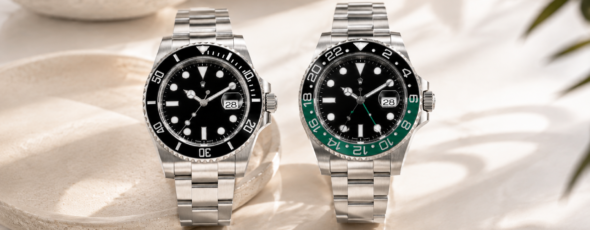
The Rolex Submariner and GMT-Master II can look closely related at first glance. Both belong to Rolex’s professional range, and both have rotating bezels, Oyster cases, and highly recognizable dial layouts.
But they were designed to solve completely different problems.
The Submariner is the stronger choice if you want a clean, highly water-resistant sports watch with a diving heritage and understated versatility.
The GMT-Master II makes more sense if you travel frequently, work across time zones, or want a Rolex with more visual character and an additional practical complication.
Neither is simply the better Rolex. The better choice depends on how you intend to wear it.
Rolex Submariner vs GMT-Master II at a Glance
For a useful modern comparison, consider the current steel Submariner Date and steel GMT-Master II. Individual specifications can differ across older references and other materials.
| Feature | Rolex Submariner Date | Rolex GMT-Master II |
| Primary purpose | Diving | Travel and multiple time zones |
| Modern steel case size | 41 mm | 40 mm |
| Water resistance | 300 metres | 100 metres |
| Bezel | Unidirectional, 60-minute scale | Bidirectional, 24-hour scale |
| Movement | Calibre 3235 | Calibre 3285 |
| Power reserve | Approx. 70 hours | Approx. 70 hours |
| Additional function | Date | Date + second time zone |
| Bracelet character | Oyster with Glidelock | Oyster or Jubilee depending on reference |
| Best suited to | Sport, water, everyday use | Travel, business, everyday use |
Rolex specifies the modern Submariner Date at 41 mm with 300 meters of water resistance, calibre 3235 and an approximately 70-hour power reserve. Current steel GMT-Master II references are 40 mm, water-resistant to 100 meters, and powered by caliber 3285 with an approximately 70-hour reserve.
Those numbers explain part of the difference. On the wrist, the personalities are even more distinct.
Two Rolex Icons Built for Different Worlds
The easiest way to understand the Submariner and GMT-Master II is to look at why each watch exists.
Rolex introduced the Submariner in 1953 as a professional diving watch. Its rotating bezel allowed divers to track immersion time, and the model became closely associated with underwater exploration. The original watch was waterproof to 100 meters; the modern Submariner family is rated to 300 meters.
The GMT-Master arrived in 1955 during the expansion of long-distance commercial aviation. It was developed to help people traveling across time zones read another time alongside local time. The GMT-Master II, introduced later, developed that idea further with an independently adjustable local hour hand.
One was built around elapsed time underwater.
The other was built around time in different parts of the world.
That distinction still defines the two collections today.
Design: Submariner Simplicity or GMT-Master II Character?
This is often where the decision begins.
Rolex Submariner
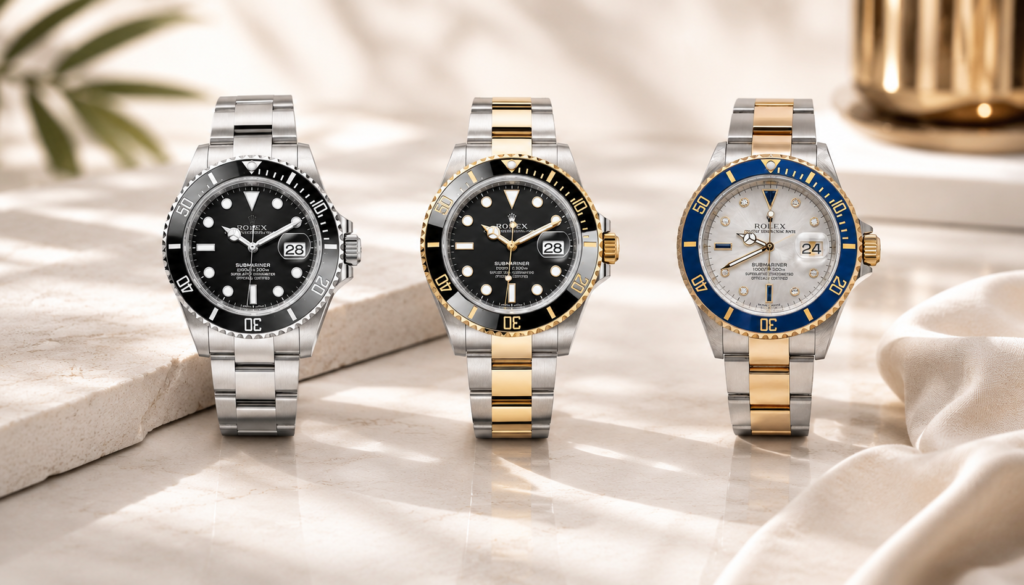
The Submariner has a remarkably focused design.
Large luminous markers, broad hands, a 60-minute bezel, and an Oyster bracelet give it the familiar Rolex sports watch appearance without adding much visual complexity.
The black Submariner and Submariner Date are particularly easy to wear because they work with almost anything. The design can move from casual clothing to business attire without demanding much attention.
Its bezel also serves a straightforward purpose. It rotates in one direction and is graduated for 60 minutes, allowing elapsed time to be measured. Rolex describes the bezel as a key functional element of the watch’s diving design.
If you prefer a Rolex that feels purposeful, balanced, and relatively restrained, the Submariner has an advantage.
Rolex GMT-Master II
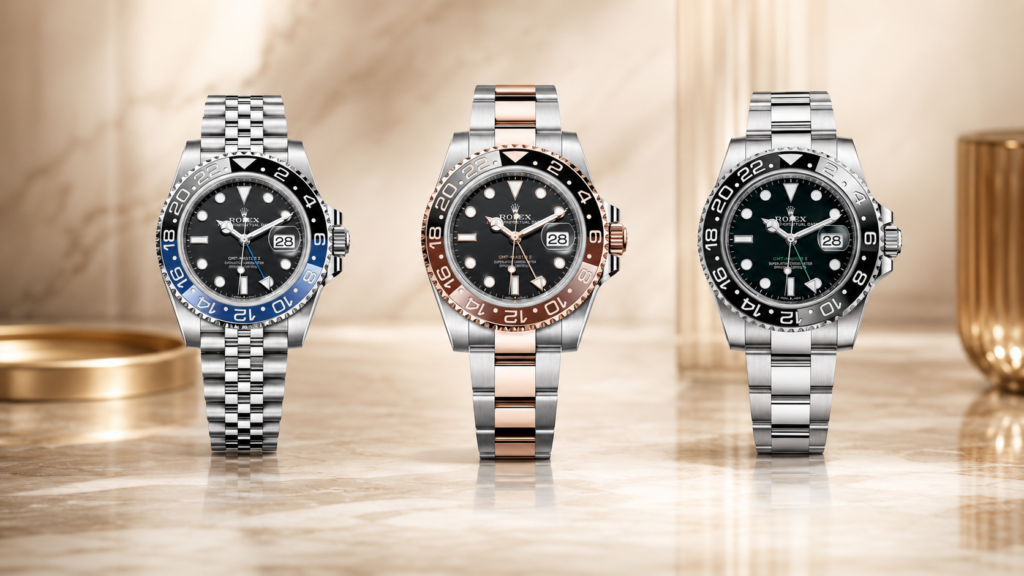
The GMT-Master II has more going on visually.
Its 24-hour bezel is one of the collection’s defining features, particularly on two-color ceramic references. Add the arrow-tipped GMT hand and, on certain models, the option of a Jubilee bracelet, and the GMT-Master II develops a more distinctive personality.
The bezel is bidirectional rather than unidirectional because its purpose is not measuring dive time. It works with the 24-hour hand to read another time zone.
If you want the watch itself to play a stronger part in your overall look, the GMT-Master II often has more presence.
Design verdict: Choose the Submariner for cleaner simplicity. Choose the GMT-Master II for greater visual identity.
Function: Do You Need a Dive Bezel or a Second Time Zone?
This is the most meaningful technical difference.
What the Submariner Does
The Submariner’s 60-minute bezel was designed to help a diver monitor time underwater.
For most owners today, it can also be useful for far more ordinary tasks: timing a meeting, a drive, a workout, or anything else where elapsed minutes matter.
The modern Submariner is water-resistant to 300 meters and uses Rolex’s Triplock screw-down crown system.
You may never dive anywhere near that depth. What the specification gives you in everyday ownership is a watch designed around strong water resistance and durability.
What the GMT-Master II Does
The GMT-Master II is designed around travel.
Its additional 24-hour hand can indicate a reference time while the conventional hour hand shows local time. The local hour hand can be moved forwards or backwards independently in one-hour increments without disturbing the minute and second hands.
That becomes genuinely useful if you regularly move between Dubai, London, New York, Singapore, or other international markets.
Even when you are not travelling, the GMT hand can keep track of another location where your family, clients, or colleagues are based.
Function verdict: The Submariner is more specialized around water and elapsed time. The GMT-Master II offers the more useful complication for frequent international travelers.
Which One Is Better for Everyday Wear?
Both can comfortably function as a daily Rolex, but they feel different.
The Submariner’s appeal is that there is very little to think about. It is easy to read, highly water-resistant, and visually straightforward.
The GMT-Master II gives you more information at a glance and has a slightly busier dial and bezel. For someone who actually uses the second time-zone feature, that added information is worthwhile. For someone who does not, the complication may be more about design than necessity.
There is also a small difference in modern case diameter: the current Submariner family uses a 41 mm case, while current GMT-Master II models use a 40 mm case. Case diameter alone, however, does not tell you exactly how a watch will feel on your wrist. Bracelet choice, case proportions, and your own wrist shape matter as well.
Whenever possible, try both on.
A one-millimeter specification difference can matter less than expected once the watches are actually on the wrist.
Oyster vs Jubilee: Does the Bracelet Change the Decision?
It can.
The Submariner is closely associated with its Oyster bracelet. Current models use the Rolex Glidelock extension system, allowing the bracelet length to be adjusted without tools. The system has obvious diving origins but is equally convenient when wrist size changes during the day.
The GMT-Master II gives buyers another aesthetic direction. Rolex currently offers the collection on Oyster or, for certain references, Jubilee bracelets. Rolex notes that the GMT-Master II is the only professional model also available with a Jubilee bracelet.
The Oyster bracelet tends to make the GMT feel sportier.
The Jubilee gives it a slightly more refined and recognizable character.
If bracelet choice matters strongly to you, that flexibility can push the decision towards the GMT-Master II.
Which Is Better for Travel?
GMT-Master II.
This is the easiest category to call.
The watch was developed around traveling between time zones, and that remains one of its most useful features. Setting the local hour independently is particularly convenient when landing in another country because the reference time can remain unchanged.
For someone based in Dubai who regularly travels internationally or communicates with several markets, the function is more than a historical talking point. It can become something you use every week.
The Submariner will travel perfectly well, of course. It simply does not provide the additional time-zone functionality.
Which Is Better for Swimming and Water Activities?
Submariner.
Both watches can handle considerably more water exposure than ordinary daily life requires, but their specifications are different.
The modern Submariner is rated to 300 meters, compared with 100 meters for the current GMT-Master II. The Submariner also has a unidirectional timing bezel and was engineered specifically around diving.
If swimming, boating, diving, or spending considerable time around water is part of your lifestyle, the Submariner is the more natural choice.
For any pre-owned watch, however, the stated model specification should not be treated as proof that an individual watch is currently waterproof. Seals age, and watches are opened for servicing. Water resistance should be checked appropriately before relying on it.
Which Looks Better with Formal Clothing?
There is no universal answer here.
A black Submariner can be surprisingly discreet with a suit because its design is relatively monochromatic.
A GMT-Master II on a Jubilee bracelet can feel slightly more polished, while a colorful bezel can make it more noticeable.
The better question is whether you want your watch to blend into what you are wearing or become part of the statement.
For understated versatility, the Submariner has an edge.
For character and recognisability, the GMT-Master II is difficult to ignore.
What About the Movements?
Modern examples are close in overall performance but different in function.
The Submariner Date reference 126610LN uses calibre 3235. It provides hours, minutes, seconds and an instantaneous date, with approximately 70 hours of power reserve.
Current GMT-Master II steel references use calibre 3285. Alongside hours, minutes, seconds, and the date, the movement provides a 24-hour display and an independently adjustable local hour hand. Power reserve is also approximately 70 hours.
For most buyers, therefore, movement choice is less about one caliber being better and more about whether the GMT function is useful to you.
Submariner Date or No-Date?
There is another decision within the Submariner family.
The current no-date Submariner reference 124060 uses calibre 3230 and keeps the dial especially clean. The Submariner Date adds the date window and Cyclops magnification familiar across much of the Rolex catalog. Both current steel versions are 41 mm and rated to 300 meters.
The no-date model appeals to buyers who value symmetry and the original simplicity of the Submariner concept.
The Submariner Date is likely to feel more practical if you regularly use a date display.
If you are already drawn to the GMT-Master II, the comparison is more naturally made against the Submariner Date because both provide a date.
Which Rolex Has the Stronger History?
There is no meaningful winner.
The Submariner has its roots in underwater exploration. Rolex launched it in 1953, and its design has become one of the most influential templates for the modern diving watch.
The GMT-Master traces its story to the growth of international aviation. The original GMT-Master appeared in 1955 as air travel was rapidly connecting distant parts of the world, while the GMT-Master II followed in 1982.
One represents exploration below the surface.
The other represents movement across the world.
Your preference is likely to say more about you than it does about either watch.
What About Buying Pre-Owned?
This is where the comparison becomes more interesting.
The pre-owned market gives you access to far more than the watches currently shown in Rolex’s catalogue. Different generations bring changes in case proportions, movements, bezels, bracelets, dial details, and overall wearing experience.
When comparing a pre-owned Submariner and GMT-Master II, do not choose by reference number or nickname alone.
Look at:
- Exact reference and production period
- Overall condition
- Case shape and previous polishing
- Dial and hand configuration
- Bracelet condition
- Service history
- Originality and known replacement components
- Box and documentation, when available
- Authenticity
- What is actually included with the watch
Two examples of the same reference can have very different histories and conditions.
That is why the quality of the individual watch matters just as much as choosing between the two collections.
At Haute Horologe, luxury watches are internally inspected before being accepted into the collection. The company does not provide standalone authentication services for customer-owned watches; the authentication process is carried out on the watches it acquires and sells so customers can purchase with confidence that the watches offered are genuine.
Rolex Submariner vs GMT-Master II: Which Should You Choose?
Here is the simplest way to make the decision.
Choose the Rolex Submariner if you:
- Prefer a cleaner, more restrained Rolex sports watch
- Spend significant time around water
- Want 300-metre water resistance in a modern model
- Find an elapsed-time bezel more useful than a GMT function
- Prefer the Oyster bracelet and Glidelock adjustment
- Want one Rolex that can move easily between casual and formal settings
Choose the Rolex GMT-Master II if you:
- Travel regularly between time zones
- Work internationally
- Would genuinely use a second-time-zone display
- Prefer a more distinctive bezel
- Like the choice between Oyster and Jubilee on applicable references
- Want your Rolex to have a little more visual personality
And if neither set of functions matters much to you?
Choose the one you keep looking at.
Luxury watches are bought to be worn and enjoyed. Technical specifications can narrow the decision, but once both watches satisfy your practical needs, the design that feels right on your wrist should carry considerable weight.
Explore Pre-Owned Rolex Watches at Haute Horologe
The Submariner and GMT-Master II have reached iconic status for different reasons. One takes its identity from the underwater world, and the other from international travel.
For some collectors, the Submariner’s simplicity is difficult to beat. For others, the GMT-Master II’s second time zone and more expressive design make it the obvious choice.
The right watch is the one that fits how you live, how you dress, and what you want from your Rolex.
Explore our collection of pre-owned Rolex watches at Haute Horologe or visit us at The Mall, Jumeirah Beach Road, Dubai.
We at Haute Horologe is an independent pre-owned luxury watch retailer and not affiliated with Rolex SA. All Rolex watches offered by Haute Horologe are pre-owned unless otherwise expressly stated.
Frequently Asked Questions
Is the Rolex Submariner better than the GMT-Master II?
Neither is universally better. The Submariner is the stronger option for water resistance, diving heritage, and a simpler design. The GMT-Master II is better suited to international travel and anyone who regularly needs to track another time zone.
Is the Submariner bigger than the GMT-Master II?
Current Submariner models have a 41 mm case, while current GMT-Master II models have a 40 mm case. Older references can have different proportions, so always check the exact reference when buying pre-owned.
Which is more water-resistant, the Submariner or GMT-Master II?
The modern Submariner is water-resistant to 300 meters, while current GMT-Master II models are rated to 100 meters.
What is the main difference between the Submariner and GMT-Master II?
The main difference is purpose. The Submariner uses a unidirectional 60-minute bezel designed for measuring dive time. The GMT-Master II uses a 24-hour hand and bidirectional 24-hour bezel to display another time zone.
Which Rolex is better for travelling?
The GMT-Master II. Its independently adjustable local hour hand and 24-hour display were specifically designed for changing time zones.
Can you wear a Rolex Submariner every day?
Yes. Although developed as a diving watch, the Submariner has evolved far beyond its original professional purpose and is widely suited to everyday wear. Rolex itself describes the model as having moved beyond the marine world.
Is a GMT-Master II suitable for everyday wear?
Yes. Its second-time-zone function is useful for travelers, while its 100-meter water resistance and Oyster case make current models practical for normal everyday use.
Should I buy a new or pre-owned Submariner or GMT-Master II?
A pre-owned watch can give you access to current and discontinued references, but condition, originality, service history, and authenticity should all be considered. Buy from a seller that can clearly explain the watch being offered and stand behind its authenticity.
Does Haute Horologe authenticate Rolex watches for customers?
No. Haute Horologe does not provide standalone Rolex authentication services. Watches are authenticated internally as part of the company’s buying, trading, and selling process so that the Rolex watches offered to customers are guaranteed genuine.